← Home · Slopes & Walls

Retaining Wall Design Columbus GA: Geotechnical Engineering for the Chattahoochee Fall Line

Together, we solve the challenges of tomorrow.

DETAILS →

A common mistake we see in Columbus is treating a retaining wall as a simple concrete pour without accounting for the saprolitic soil profile. The Fall Line runs right through the city, creating a transition zone where Piedmont residual silts overlie Coastal Plain sands. This geological boundary produces highly variable bearing capacity within a single lot. A wall built on assumed homogeneous material often tilts within two seasons. Our retaining wall design starts with SPT drilling to refusal depth and laboratory classification per ASTM D2487 before any geometry is drafted. The 2018 IBC and ASCE 7-22 demand lateral earth pressure calculations that reflect the actual phi angle of the onsite residual micaceous silt, not a textbook default. Columbus experiences heavy summer storms that saturate the upper colluvium, so we integrate subsurface drainage into the structural model from day one. For sites near the Chattahoochee River, where floodplain organics appear, we often supplement the analysis with in-situ permeability testing to calibrate the hydraulic gradient behind the stem.

A retaining wall on Columbus's residual soil without site-specific friction angle testing is a liability, not an asset.

Process overview

One thing our field team observes repeatedly across Muscogee County is the presence of partially weathered gneiss at depths as shallow as five feet. That rockhead can act as a natural heel key for a gravity wall, or it can force a switch to a drilled shaft foundation if the design calls for an MSE structure with deep reinforcement grids. Our deliverables include global stability checks using Spencer's method for walls exceeding eight feet, per AASHTO LRFD 2020 specifications. We evaluate sliding, overturning, and bearing capacity under both static and seismic conditions, referencing the USGS unified hazard tool for Columbus's spectral acceleration values. Wall types we design routinely include: cantilever reinforced concrete, modular block MSE with geogrid, soldier pile with lagging for tight urban setbacks, and gabion walls for erosion-prone creek banks. Each design package comes with a construction sequence that spells out compaction requirements behind the wall: 95% of modified Proctor density, verified by nuclear gauge, and no heavy compaction equipment within three feet of the stem. The Proctor testing data informs the backfill specification directly, reducing the risk of post-construction settlement that pulls the wall out of plumb.
Retaining Wall Design Columbus GA: Geotechnical Engineering for the Chattahoochee Fall Line
Technical reference image — Columbus Georgia

Local context

A 14-foot MSE wall on Veterans Parkway failed three years after construction because the designer used a generic friction angle of 30 degrees for the foundation soil. The actual material was partially saturated micaceous silt with a drained phi of 24 degrees. The wall rotated outward, cracking the asphalt of the adjacent commercial parking lot. Remediation cost exceeded the original construction budget by a factor of two. That failure illustrates the core risk in Columbus: the Piedmont residual profile is not a textbook soil. Its strength depends on relic structure from the parent gneiss, and the water table fluctuates dramatically between October drought levels and March perched conditions. Our retaining wall design explicitly models these seasonal pore pressure variations. For walls with a surcharge load from a building or roadway, we run bearing capacity analysis under eccentric loading conditions and specify a minimum embedment depth that accounts for scour if the wall is within 50 feet of a drainage channel. The Muscogee County permitting office now requires a Georgia-licensed engineer's seal on any wall over four feet with a surcharge, a direct response to several local failures.

Need a geotechnical assessment?

Reply within 24h.

Email: contact@geotechnicalengineering1.sbs

Technical parameters

ParameterTypical value
Height range designed3 ft to >30 ft (cantilever, MSE, anchored)
Design methodologyASCE 7-22, AASHTO LRFD 2020, IBC 2018
Seismic coefficient (kh)Site-specific per USGS hazard maps (Columbus PGA ~0.12g)
Backfill specification95% modified Proctor (ASTM D1557), free-draining granular
Drainage systemContinuous toe drain + granular chimney, filtered per FHWA guidelines
Global stabilitySpencer or Morgenstern-Price method, factor of safety ≥1.5
Soil parameters sourceSPT N60, triaxial CU, Atterberg limits (ASTM D4318)

Additional services

01

Cantilever and Gravity Wall Engineering

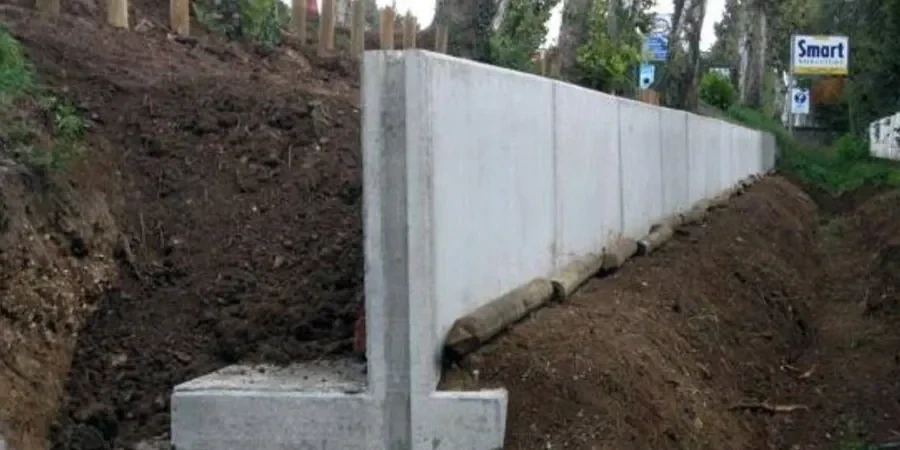
Full structural design including stem, toe, and heel reinforcement per ACI 318-19. We calculate active and at-rest earth pressures using Coulomb or Rankine theory, adjusted for wall friction and backslope angle. Each design includes a drainage specification and a construction QA/QC checklist for backfill placement.

02

MSE Wall and Slope Reinforcement Design

Geogrid layout, facing connection design, and global stability analysis for mechanically stabilized earth walls. We specify grid type (polyester or HDPE), vertical spacing, and embedment length based on the friction angle of the reinforced fill, confirmed by laboratory shear testing.

Reference standards

IBC 2018, Chapter 18 (Soils and Foundations), ASCE 7-22, Minimum Design Loads for Buildings and Other Structures, AASHTO LRFD Bridge Design Specifications, 2020 (Section 11: Abutments and Retaining Walls), ASTM D1586-18 (Standard Penetration Test), ASTM D2487-17 (Unified Soil Classification System), FHWA-NHI-10-024 (MSE Walls and Reinforced Soil Slopes)

FAQ

What is the cost range for retaining wall design in Columbus, GA?

Retaining wall design fees in Columbus typically range from US$1,090 to US$4,740 depending on wall height, complexity, and whether subsurface investigation is included. A simple 6-foot garden wall with standard backfill costs less; a 20-foot MSE wall with surcharge loading, global stability analysis, and seismic design falls at the upper end.

Does Columbus require a permit for retaining walls?

Yes. The City of Columbus enforces IBC 2018, and any retaining wall over four feet in height or supporting a surcharge requires a building permit with sealed engineering drawings. Walls near the Chattahoochee River may also need a floodplain development permit and an erosion control plan approved by the Columbus Stormwater Division.

How do you handle the gneiss bedrock during wall design?

When the SPT drilling encounters refusal on partially weathered gneiss, we adjust the foundation strategy. For cantilever walls, the rock can serve as a bearing stratum if the top is leveled with lean concrete. For MSE walls, we may shorten the reinforcement length and key the facing into the rock to prevent sliding. The design includes a transition detail between the soil and rock interface.

What drainage measures do you specify behind the wall?

We design a two-stage drainage system: a continuous perforated toe drain at the base of the stem, wrapped in ASTM D4491 geotextile, and a granular chimney drain extending to within 12 inches of the finished grade. For walls in the Columbus clayey silt, we also specify a waterproofing membrane on the back face of the stem to prevent efflorescence and freeze-thaw damage.
Location and service area

We serve projects across Columbus Georgia and its metropolitan area.

View larger map