Contractors in Columbus quickly learn that the red clay here doesn’t behave like the soil 90 miles north in Atlanta. We see it constantly at the lab—samples pulled from sites near the Chattahoochee River or up toward the Piedmont transition zone show wide variance in optimum moisture. That’s why running a Proctor test early, before grading starts, saves rework. The Fall Line geology puts Columbus right where crystalline bedrock gives way to coastal plain sediments, meaning two lots half a mile apart can need completely different compaction specs. Our team runs ASTM D698 and D1557 daily. We pair the Proctor curve with field sand cone density checks so the numbers from the lab actually match what the roller is achieving on the lift.
A one-percent error in optimum moisture on a 20,000-yard fill job in Columbus clay can mean weeks of recompaction and failed density tests.
Process overview
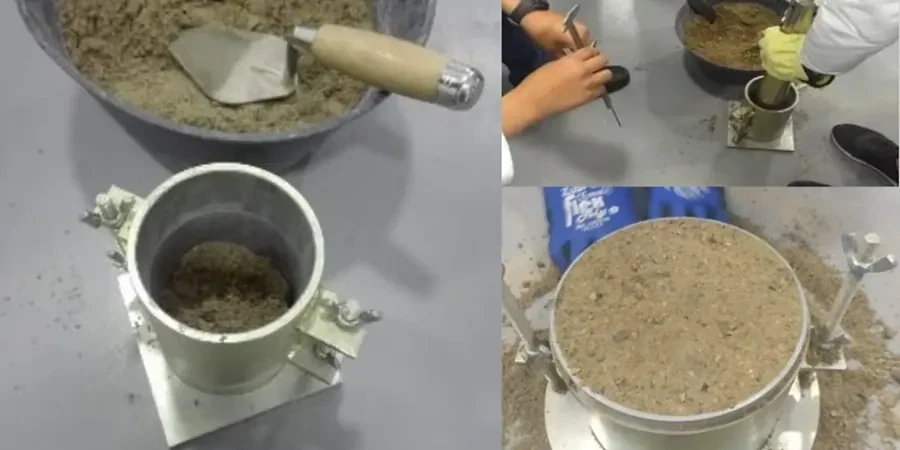
ASTM D698 (Standard Proctor) and ASTM D1557 (Modified Proctor) are the backbone of earthwork acceptance in Muscogee County. GDOT and the Columbus Consolidated Government both reference these methods in their specs. Standard Proctor uses a 5.5 lb hammer dropped 12 inches; Modified jumps to a 10 lb hammer dropped 18 inches, delivering roughly 4.5 times more compactive effort. The difference matters. In Columbus, where residual silty clays often sit atop partially weathered schist, a Standard Proctor curve can mislead if the structural fill will actually see heavy vibratory compaction. We run the test on material passing the No. 4 sieve, determine the moisture-density relationship across at least four points, and deliver a clean curve with maximum dry density and optimum moisture content clearly marked. Every mold is weighed to 0.1 gram precision. We also check for oversize correction when gravel content exceeds 5%, which is common in fill sourced from local quarries near the river. The lab maintains a constant-temperature curing room so moisture conditioning is consistent—critical in Georgia’s summer humidity when a sample left on the bench can lose half a percent of water in ten minutes.
FAQ
What’s the price range for a Proctor test in Columbus, GA?
A Standard Proctor (ASTM D698) typically runs US$90–$130 per sample. A Modified Proctor (ASTM D1557) ranges from US$150–$240 depending on whether the 4-inch or 6-inch mold is specified and if oversize correction is needed. Rush turnaround adds a small surcharge.
How long does it take to get Proctor results from your Columbus lab?
Standard turnaround is two to three business days from the time we receive the sample. We offer a 24-hour rush service when the contractor needs the curve to start compaction the next morning—call ahead so we can schedule it.
Do I need Standard or Modified Proctor for my Columbus project?
It depends on the spec. Residential plumbers and small site contractors usually need Standard Proctor (ASTM D698). Commercial building pads, GDOT work, and any fill that will see heavy roller compaction almost always require Modified Proctor (ASTM D1557). If the project manual just says “Proctor,” send us the spec section and we’ll help you confirm.
How much material do you need to run a Proctor test?
We need about 50 pounds of representative soil for a 4-inch mold or roughly 80 pounds for a 6-inch mold. The material should be bagged and sealed immediately after excavation to preserve field moisture. For Columbus sites with visible gravel, include a few extra pounds so we can run a proper oversize correction per ASTM D4718.