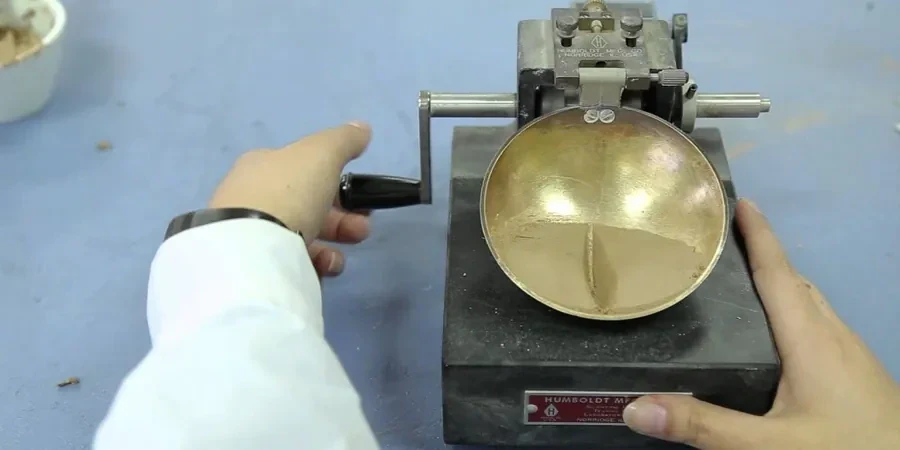
The brass cup drops 25 times in the liquid limit device, striking the hard rubber base at two revolutions per second. For Columbus Georgia projects, that standardized mechanical rhythm determines whether the local residual silts and alluvial clays behave as a solid or a fluid under load. Our laboratory runs ASTM D4318 on samples pulled from sites across Muscogee County, where the Piedmont saprolite weathers into fine-grained soils that contractors frequently misread as stable simply because they stand vertical in an excavation. The Atterberg limits cut through that visual bias, giving you the liquid limit, plastic limit, and plasticity index needed to classify the soil per the Unified Soil Classification System. When paired with a grain size analysis on the same sample, the combined data set supports bearing capacity calculations and pavement design that hold up against Georgia's wet-dry seasonal swings.
The plasticity index is not just a classification number. It controls swell potential, shrink-swell cycles, and the long-term serviceability of pavements and shallow foundations in the Piedmont residual soils.
Process overview
A common mistake in the Columbus area is treating the reddish silty clays derived from weathered mica schist as low-plasticity fill without verifying the numbers. These materials often plot near the A-line on the plasticity chart, and a shift of just a few points in the liquid limit changes the classification from CL to MH, which carries completely different drainage and compaction requirements. The Atterberg limits test gives you that distinction in hard numbers. We dry the sample at 110 degrees Celsius, sieve it through the No. 40 screen, and remix it with distilled water to target moisture contents that bracket the closure of the standardized groove. The plastic limit is rolled into 3.2-millimeter threads until they crumble, a direct measure of the moisture content where the soil transitions from plastic to semisolid behavior. For jobs near the Fall Line where Columbus sits, the sudden change from crystalline Piedmont rock to Coastal Plain sediments creates abrupt soil transitions across a single site, and
test pits let us map those boundaries before lab testing begins.
The plasticity index, calculated as the difference between the liquid limit and the plastic limit, feeds directly into empirical correlations for undrained shear strength, preconsolidation pressure, and swell potential. In the compressible alluvium along the Chattahoochee River, a PI above 25 often signals expansive clay behavior that will damage lightly loaded slabs and pavements if ignored. Our lab reports include the complete moisture content versus blow count plot, not just the final numbers, so you can see the flow curve and verify that the test met the repeatability requirements of ASTM D4318-18. For deep foundation design where the Atterberg limits indicate soft, high-plasticity strata, we recommend supplementing the data with an
SPT drilling program to obtain undisturbed strength profiles and confirm the depth to competent bearing material.
Local context
A warehouse slab on Victory Drive showed edge curling and longitudinal cracks within eighteen months of placement. The site investigation had skipped Atterberg limits testing, relying instead on a visual classification that called the reddish-brown material a sandy silt. Core samples taken after the distress appeared revealed a liquid limit of 48 and a plasticity index of 22, placing the soil squarely in the CH category. The moisture-sensitive subgrade had undergone cyclic swelling and shrinkage beneath the slab, driven by seasonal water table fluctuations in the Chattahoochee River alluvium. The repair required removing the slab, excavating the active zone to a depth of four feet, and recompacting a lime-stabilized subgrade. That single omission cost the owner more than the entire geotechnical investigation would have. Columbus sits on a geological boundary where Piedmont metamorphic rocks give way to Coastal Plain sediments over a distance of just a few miles, and soil plasticity can change radically between borings on the same lot. The Atterberg limits provide the quantitative trigger for deciding whether a soil can be reused as structural fill, needs chemical stabilization, or must be undercut entirely.
Relevant standards
ASTM D4318-18 – Standard Test Methods for Liquid Limit, Plastic Limit, and Plasticity Index of Soils, ASTM D2487-17 – Standard Practice for Classification of Soils for Engineering Purposes (Unified Soil Classification System), IBC 2021 Chapter 18 – Soils and Foundations, referencing geotechnical classification requirements
FAQ
What do Atterberg limits testing cost for a typical Columbus residential lot?
For a single sample, liquid limit and plastic limit determination runs between US$60 and US$90 when submitted as part of a broader geotechnical testing package. The total depends on the number of samples and whether associated tests like grain size analysis or Proctor compaction are requested simultaneously.
How does the local geology in Columbus affect the Atterberg limits results?
Columbus straddles the Fall Line, so soils derived from Piedmont schist and gneiss in the northern part of the city tend to be silty with moderate plasticity, while the southern areas transition into Coastal Plain sediments that can include highly plastic, smectitic clays. Testing is essential because the plasticity can vary dramatically over short distances, and a classification that works for one lot may be completely wrong for the adjacent parcel.
Can Atterberg limits results be used to estimate swell potential?
Yes, the plasticity index is a primary indicator of swell potential in fine-grained soils. A PI above 15 generally indicates some swelling tendency, and values above 25 correlate with high to very high expansion potential. Our reports include correlations to the Seed-Woodward swell potential classification to help engineers decide whether chemical stabilization or moisture conditioning is warranted before placing foundations or slabs.