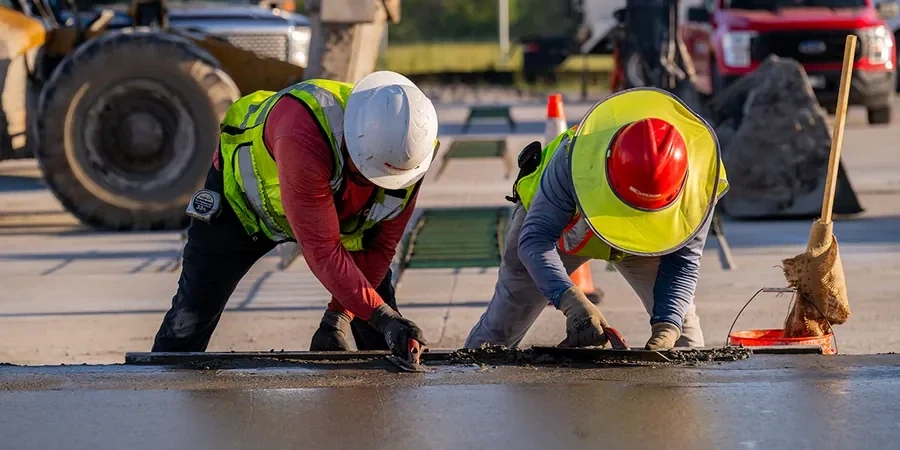
Columbus sits on the Fall Line where the Piedmont meets the Coastal Plain, meaning rigid pavement subgrades here can shift from weathered schist and gneiss to deep saprolitic soils within a single project site. That transition demands more than a generic pavement catalog solution. Our team integrates subgrade modulus values from test pits and CPT soundings directly into the AASHTO 1993 rigid pavement design procedure, matching joint spacing and dowel requirements to the actual support conditions. With average summer temperatures pushing 92°F and occasional winter freezes, the concrete slab curl stresses are real, and we account for them in every thickness calculation. We also tie the design to the local Muscogee County stormwater regulations, ensuring the pavement section drains properly without softening the subgrade.
Concrete pavement fails from the bottom up: a 10% underestimation of subgrade modulus can double the fatigue damage in the slab corner.
Local context
Columbus recorded a population of approximately 207,000 in the 2020 census, and the resulting traffic growth on corridors like Veterans Parkway and Manchester Expressway keeps pushing rigid pavement design beyond the standard county road assumptions. The real risk on local rigid pavements is not the concrete quality — it is subgrade pumping at the slab corners when the base layer lacks adequate permeability. In Muscogee County's humid subtropical climate, with 49 inches of annual rainfall, water trapped beneath a slab can erode the support within two years if the drainage path is interrupted. We specify a minimum 4-inch open-graded drainage layer wrapped in geotextile for any rigid section carrying more than 500 trucks per day, a detail often omitted in lower-bid designs. Another Columbus-specific concern is the presence of residual micaceous soils from weathered Piedmont rock: these compress under repeated loading and lose strength when wet, causing progressive faulting between adjacent slabs. Our pavement design approach includes a sensitivity analysis on the k-value to bracket the worst-case saturated condition.
Relevant standards
AASHTO Guide for Design of Pavement Structures (1993 edition, with 1998 supplement), ASTM C78/C78M — Flexural Strength of Concrete (Modulus of Rupture), ACI 360R-10 — Guide to Design of Slabs-on-Ground, ASTM D1196/D1196M — Nonrepetitive Static Plate Load Tests of Soils for k-value, Georgia DOT Standard Specifications — Section 430 (Portland Cement Concrete Pavement)
FAQ
How much does rigid pavement design cost for a project in Columbus?
For a typical commercial or industrial project in Muscogee County, the geotechnical investigation and rigid pavement design package ranges from US$1,830 to US$6,490, depending on the area, number of borings or CPT soundings required, and whether specialized testing like plate load for k-value is included. A small parking lot with two borings falls at the lower end; a distribution center with multiple truck lanes and drainage design moves toward the upper range.
What is the difference between AASHTO rigid pavement design and the PCA method?
The AASHTO method (1993/1998) is an empirical procedure based on the AASHO Road Test data, using the modulus of subgrade reaction (k-value), concrete modulus of rupture, traffic in equivalent single axle loads (ESALs), and a serviceability loss criterion. The PCA method is based on finite element analysis of slab stresses, considering axle loads at slab edges and corners, and does not use ESALs directly. We typically apply AASHTO for public roadway projects in Georgia since GDOT references it, and use PCA for industrial floors where joint spacing and load-transfer requirements differ.
Do you account for Columbus climate conditions in the rigid pavement design?
Yes, the temperature gradient through the slab thickness is a critical input for curl and warping stress analysis. We use NOAA climate data for Columbus — specifically the average summer maximum of 92°F and the winter minimum of 34°F — to compute the maximum positive and negative temperature differentials. These values directly influence the required slab thickness and joint reinforcement, and they are specific to the Chattahoochee Valley region, not generic national defaults.