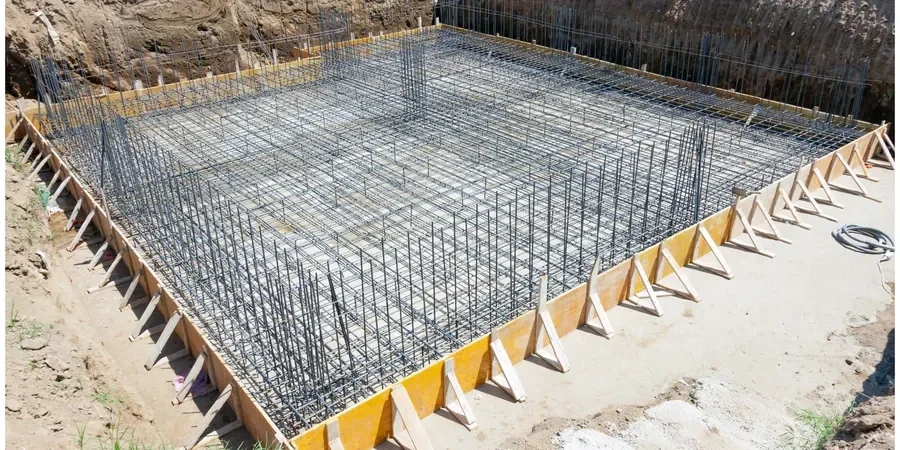
Columbus sits right on the Fall Line—elevation drops from 600 feet in the Piedmont uplands to nearly 200 feet in the Coastal Plain within a few miles. That ancient shoreline left behind a chaotic mix of residual silts, weathered schist, and loose alluvial sands that makes uniform foundation support a real headache. When column loads get heavy, isolated footings just don't cut it. We see footings that pass initial bearing checks but fail differential settlement criteria on the silty side of town. A raft foundation bridges those transitions, spreading load across the erratic profile so the whole mat moves as one rigid body. Our lab runs the index and strength testing that feeds the soil-structure interaction model—Atterberg limits, consolidation curves, and SPT-based stiffness profiles—directly from cores taken within the Chattahoochee Valley footprint. For sites near the river where liquefaction potential exists in clean sands below the water table, the mat design incorporates post-liquefaction bearing checks per NCEER methodology. Columbus is growing fast north of JR Allen Parkway, and the big-box distribution centers going up demand mat thicknesses grounded in local stratigraphy, not textbook defaults.
A raft foundation in Columbus must handle the Fall Line transition—where bearing soils change from residual silt to alluvial sand in less than a building length.
Process overview
We start every raft foundation project with a calibrated drilling rig working the Columbus residual soil profile—typically a stiff lean clay weathered from mica schist, grading into partially weathered rock within 15 to 25 feet. The rig extracts 3-inch split-spoon samples at 5-foot intervals for
SPT drilling, and where refusal hits shallow, we switch to rock coring with a T2-101 barrel to capture the top of the Piedmont crystalline basement. Back in the lab, one-dimensional consolidation tests per ASTM D2435 give us the compression index and preconsolidation pressure that govern mat settlement. What surprises engineers unfamiliar with the area is how much the soil modulus varies laterally—two borings 80 feet apart can show a threefold difference in constrained modulus. We also run a full particle-size distribution on each distinct stratum, since the silt content directly affects the drained friction angle used in the bearing capacity equation. For the heaviest warehouse slabs with racking loads exceeding 5 kips per post, we pair the consolidation data with a
triaxial CU test to nail down effective stress parameters for the finite element model. The mat design then follows ACI 360R guidance for slab-on-grade stiffness, but with subgrade reaction moduli derived from our In-Situ rather than conservative handbook values. Every boring log includes a photo of the split-spoon sample in the liner, so the structural engineer can see the mica flecks and iron oxide staining characteristic of the Columbus formation.
Local context
The Columbus climate throws two opposite problems at mat foundations: summer thunderstorms that saturate the upper 5 feet in a single afternoon, and drought cycles that shrink the same clay-rich silts until they pull away from the slab edge. That wet-dry swing creates a seasonal heave-and-settle rhythm that a properly designed raft must ride out without cracking. We measure the swell potential via ASTM D4546 on undisturbed Shelby tube samples, and if the heave exceeds half an inch, we specify a void form system beneath grade beams or a compacted select-fill cushion that isolates the mat from the active zone. Another risk unique to the Fall Line is the presence of decomposed rock lenses—zones where the schist has weathered to a micaceous sand with zero cohesion. A mat bearing partly on stiff silt and partly on that loose residual sand will tilt unless the design includes a thick enough mat section to redistribute column loads over the soft spots. Our reports flag those transitional contacts explicitly, with cross-sections drawn from the boring data so the structural engineer sees exactly where the mat stiffness needs to step up. Columbus building officials expect that level of detail, and we've supported permit packages for tilt-wall warehouses, cold storage facilities, and municipal pump stations across Muscogee County.
Relevant standards
IBC 2021 Chapter 18: Soils and Foundations, ASCE 7-22 Section 12.13: Foundation Design Requirements, ACI 360R-10: Guide to Design of Slabs-on-Ground, ASTM D2435/D2435M-11: One-Dimensional Consolidation Properties of Soils, ASTM D4546-21: Standard Test Methods for One-Dimensional Swell or Collapse of Soils, ASTM D1586-18: Standard Test Method for SPT and Split-Barrel Sampling
FAQ
What does a raft foundation design package cost for a Columbus commercial building?
For a typical commercial project in Columbus—think a 30,000-to-80,000-square-foot warehouse or retail slab—a complete geotechnical investigation with mat foundation design parameters runs between US$1,070 and US$4,400. The spread depends on the number of borings required, whether rock coring is needed, and how many consolidation and swell tests the soil profile demands. A smaller tilt-wall building on relatively uniform soil sits at the lower end; a distribution center spanning the Fall Line transition with variable fill and shallow rock pushes toward the upper range.
How does the Fall Line geology affect mat foundation thickness in Columbus?
The Fall Line creates abrupt lateral changes in soil stiffness across a building footprint. Where residual Piedmont silt (stiff, preconsolidated) transitions to Coastal Plain sand (loose to medium dense) within the same mat, the design must be thick enough to bridge the softer zone without excessive differential settlement. We typically see mat thicknesses between 24 and 48 inches for Columbus commercial slabs, with the upper end reserved for sites where borings show more than a 30-foot change in depth to competent bearing within the building perimeter. The consolidation testing we run on the silts gives us the modulus to size that thickness accurately.
Which laboratory tests are essential for designing a mat foundation in the Chattahoochee Valley?
The core tests are one-dimensional consolidation (ASTM D2435) for settlement prediction, Atterberg limits (ASTM D4318) to classify the silt-clay behavior, and particle-size distribution (ASTM D6913) to confirm the drained friction angle. If the mat will bear on soils with high mica content—common in weathered Columbus schist—we add triaxial consolidated-undrained tests (ASTM D4767) because micaceous soils have lower effective friction angles than standard correlations predict. Swell-consolidation tests (ASTM D4546) are critical when the upper 5 feet shows plasticity index above 15, which is typical of the Columbus residual silts.
Can a raft foundation be designed without rock sockets when shallow rock is present in Columbus?
Yes, in many cases. If the top of the weathered Piedmont rock lies 15 to 25 feet below grade and the overlying residual soil has adequate stiffness, the mat can bear directly on the soil without socketing into rock. We verify that the combined soil-rock profile meets the 1-inch total and half-inch differential settlement limits under the design loads. Where the rock surface is highly irregular—dips, pinnacles, or weathered seams—a mat is actually preferred over isolated footings because it averages out the bearing variability without needing to chase rock across every column line.